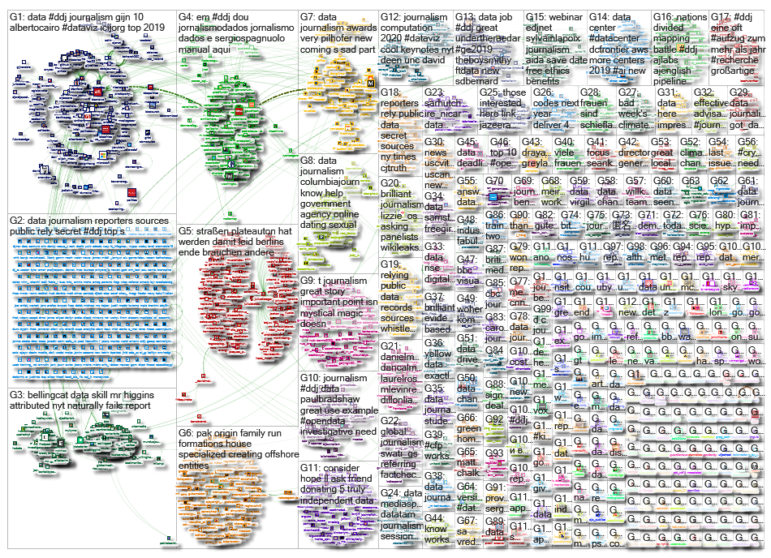
What’s the global data journalism community tweeting about this week? Our NodeXL #ddj mapping from December 2 to 8 finds The New York Times visualizing particle pollution in augmented reality; various media outlets investigating #29Leaks, a global reporting project based on a massive data leak from an offshore services provider; Columbia Journalism Investigations and ProPublica digging into the problem of sexual predators lurking in dating apps; and The International Consortium of Investigative Journalists breaking down the significance of the China Cables.
How Polluted is Your City’s Air?
Particle pollution may be too small for the eye to see, but in high concentrations it can cast a haze in the sky and wreak havoc on human health. The New York Times visualized the damaging, tiny particles in augmented reality and created an interactive for readers to compare the level of air pollution in different cities. Data visualization expert Alberto Cairo breaks down what this project gets right.
SO creepy/cool: Using the NYT app, you can see the air quality visualization over your own environment via augmented reality. https://t.co/aSubhP5HQs pic.twitter.com/BxWprxHJw5
— John Schwartz (@jswatz) December 3, 2019
#29Leaks
#29Leaks is a collaborative reporting project based on 131GB worth of data leaked from a breach at Formations House, an offshore company formation agent. Journalists from more than 20 media outlets in 18 countries dug through millions of the leaked emails, faxes, and phone calls to piece together Formation House’s global reach and the criminal activities of the companies it had registered. The Organized Crime and Corruption Reporting Project (OCCRP) has a video explainer of the scheme here.
Pak origin family run UK company, specialised in creating shell companies across the globe, is at the middle of a worldwide collaborative journalism investigation after several hundred thousand documents were disclosed in what is being termed as #29Leaks.https://t.co/9li5aorWwy
— Economic Times (@EconomicTimes) December 4, 2019
Sexual Assault and Dating Apps
Columbia Journalism Investigations and ProPublica analyzed more than 150 incidents of sexual assault involving dating apps, culled from a decade of news reports, civil lawsuits, and criminal records. Their findings revealed that Match Group, which owns most major online dating services, screens for sexual predators on Match.com — but not on Tinder, OkCupid, or PlentyofFish. Now, the reporters are asking readers to contribute their personal stories.
We’re trying to figure out what dating platforms are and are not doing to stop preventable harm. We need help gathering as many examples as we can.
If you’ve flagged sexual assault or rape to a dating app, we hope you’ll fill out this questionnaire. https://t.co/Ljv4Dfi4hc
— ProPublica (@propublica) December 3, 2019
Mapping Canada’s Pipeline Battle
Canada’s plan to extend the Trans Mountain oil pipeline from Edmonton to the country’s west coast has been subject to much debate. Environmentalists and Indigenous groups say they weren’t adequately consulted on the project. Al Jazeera traveled more than 2,000 km along the pipeline route to speak to Indigenous and community leaders as well as legal experts.
2,000+km, dozen+ interviews, questions of ownership, governance & Indigenous rights/resistance.
Read/watch/interact with @jkdamours & @megan_otoole's "Nations Divided: Mapping Canada's Pipeline Battle" https://t.co/MmFu1X6KwP
(with the brilliant @haddadme @AJEnglish @AJlabs) pic.twitter.com/nQ1t0U7dhX
— Laurin-Whitney Gottbrath (@ElleDubG) December 5, 2019
All You Need to Know: China Cables
The China Cables investigation is based on classified Chinese government directives that provided operational plans for internment camps and orders for carrying out mass detentions of Uighurs and other ethnic minorities living in Xinjiang, China. The International Consortium of Investigative Journalists explains who is involved and the significance of the leaked documents.
Still have questions: Where is Xinjiang? Who are the Uighurs? And what documents were in #ChinaCables?
We have answers: https://t.co/86zHtWuTwS pic.twitter.com/um0TA7PAla
— ICIJ (@ICIJorg) November 25, 2019
Mapping Spatial Inequality
The Financial Times mapped inequality in the United Kingdom, using different colors to indicate different socioeconomic classes. It also examined how social researcher and reformer Charles Booth’s 19th century maps of poverty are being updated for the 21st century.
Absolutely fantastic stuff from @undertheraedar and @theboysmithy! Acetates, inequality maps, field-trips, qualitative interviews, critical analysis. This is proper old-skool geography for the 21st Century – memories of Lancaster undergrad days. Love it! https://t.co/FR3aA6M2Hh
— Adam Dennett (@adam_dennett) December 4, 2019
The Future of Data Journalism Awards
Wondering about the fate of the Data Journalism Awards after the closure of the Global Editors Network? Nieman Lab finds out that former jury members Reginald Chua of Reuters and Aron Pilhofer of Temple University are working with a few others to develop a new group and a recognition process independent of the original awards. They welcome suggestions for a name for the new version.
Very very sad the Data Journalism Awards (which I was a part of from the beginning) have gone away.
Absolutely thrilled to be working with @reginaldchua and a global, grassroots team to build what’s next.https://t.co/IsPwyeloX8
Much more to come! Watch this space.
— Aron Pilhofer (@pilhofer) December 4, 2019
Mining Social Media
The book Mining Social Media: Finding Stories by Lam Thuy Vo was just released last week. It covers how and where to find data from the social web and the tools necessary to process, explore, and analyze it.
How can journalists go from observing the social web to understanding it on a more meaningful, deeper level? We've got an excerpt from a brand-new book by @lamthuyvo. https://t.co/RaNdrJ43mz
— OpenNews Source (@source) December 3, 2019
The 100th Edition: Fair Warning Newsletter
Fair Warning — a newsletter by data journalist Sophie Warnes — has reached its 100th edition. Subscribe here if you’re interested in data journalism, data visualization, and storytelling. The links that Warnes has curated for over two-and-a-half years are now searchable in an archive, inspired by Jeremy Singer-Vine’s Data is Plural archive.
Congratulations @sophiewarnes for the 100th edition of Fair Warning newsletter. https://t.co/0XIJ9n13CE via @revue (if you are into data journalism, data visualisation, and storytelling from both sides of the pond, highly recommend signing up and also supporting Sophie's work)
— Raju Narisetti (@raju) December 8, 2019
Rental Burden in Germany
Rising rental rates are burdening many people in Germany, particularly low income earners. Low wage workers who live in comparatively cheap apartments need to fork out 31% of their salary for rent compared to higher income earners at 22%, even when the latter tends to live in more expensive homes. Zeit Online explores the rental market problem using reports, data analysis, and interviews.
So eine Karte gabs noch nie: Wie leiden Geringverdienende unterm Mietenboom? Für jede Gemeinde in Deutschland. https://t.co/CEHaJOdWQ6 #mietenamlimit #miete Ein mega Projekt mit @juliustroeger @GrabitzG @colorfuldata @julians
— Marlies Uken (@Marlies_Uken) December 5, 2019
Thanks again to Marc Smith of Connected Action for gathering the links and graphing them. The Top Ten #ddj list is curated weekly.
 Eunice Au is GIJN’s program coordinator. Previously, she was a Malaysia correspondent for Singapore’s The Straits Times, and a journalist at the New Straits Times. She has also written for The Sun, Malaysian Today, and Madam Chair.
For a look at NodeXL’s mapping on #ddj and data journalism on Twitter, check out this map.